Thrive News

Nine Southeast counties join in revitalization effort

Effort underway to deal with the region's persisting problems of poverty and poor health

People from nine counties in southeast Kansas are banding together in an effort to revitalize the region, which is the state's poorest.

KHI News Service
Sept. 13, 2010


 — People from nine southeast Kansas counties are banding together in an effort to revitalize the region, which last prospered decades ago before the coal played out and the railroad hubs vanished.

David Toland, executive director of Thrive Allen County, a non-profit group in Iola supported by the REACH Healthcare Foundation that works to improve the health of the county’s residents, laments what he calls the region’s, “century-long decline.”

“We have the worst poverty in the state,” he said. “We have the worst housing conditions. We have a manufacturing-based economy that is facing a major realignment that is already underway. And we die too young and unnecessarily in many cases. It’s imperative that we come together as a region and accept that unless we do something about this now the region will not survive another 100 years.”

Toland, a seventh-generation southeast Kansan, left a budding career as city planner in Washington, D.C. two-and-a-half years ago to return to his native Iola and take the Thrive Allen County job.

photo

David Toland

When the Kansas Health Institute issued a report in the summer of 2009 that ranked southeast Kansas the least healthy region in the state, Toland took note.

When the ranking was confirmed by a later national reportToland sensed an opportunity to act.

In April, he spearheaded a meeting, inviting people from each of the region’s counties.

Not only did representatives of all nine counties show up in Iola, they agreed to explore how they might cooperate more and compete less to improve the health of the region’s residents. An executive committee was formed.

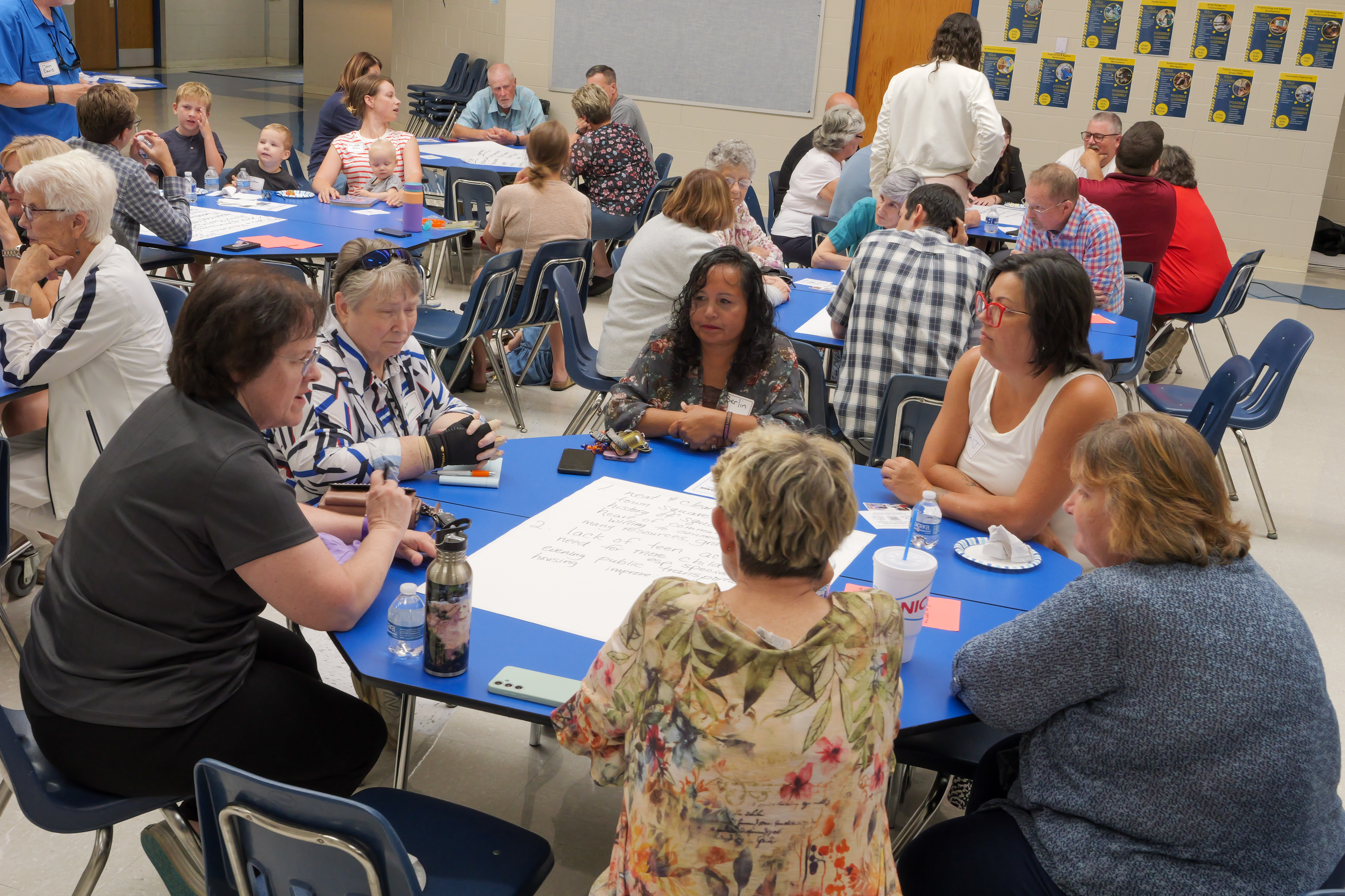
A second summit was held Aug. 31 in Parsons. Toland and the group – more than 60 city and county officials, educators, public health professionals and community leaders – drew assistance from the Kansas Health Institute, the Kansas Health Foundation, the Kansas Leadership Center and the REACH Healthcare Foundation.

“I think we definitely built on the progress we made in the first meeting in trying to get these neighbors in southeast Kansas – these nine counties – to come together and recognize that we have common challenges and that if we address them in a unified fashion that we can actually make a difference,” he said.

A “goose bumps” moment

Elizabeth Ablah doesn’t live in southeast Kansas. The assistant professor of preventative medicine at the University of Kansas School of Medicine in Wichita traveled to Parsons for the meeting only because she had been invited to help facilitate the discussion. It was a role that she had played dozens of times before. But she said the summit held by the Southeast Kansas Regional Health Inititiative was unlike any other meeting she has worked.

photo

Elizabeth Ablah

“I have never been to a community meeting before in my life where the entire room was willing to disregard all of their specific soapbox issues and they were instead willing to dedicate all of their motivation, energy and their interest to working together to address these issues as a nine-county region,” Ablah said. “I’m getting goose bumps thinking about it again. That is extremely powerful to me and is a strong indicator that this can be a successful initiative.”

Mark Johnson, a lifelong southeast Kansas resident who teaches in the College of Technology at Pittsburg State University, was among those at the meeting.

“If we do, it will work,” Johnson said. “But we’ve got to take that first step. You can’t wait on somebody else. We’ve got to take action.”

“If you’re not willing to step up and make a difference, how can you expect anyone else to,” said Amy Root, another participant.

Root is a single mother and registered nurse. Her family has lived in Cherokee County for five generations.

Barbecue before dark

Krista Postai is director of the Southeast Kansas Community Health Center in Pittsburg. At the Iola meeting, she said she hoped that the determination to work together would set this most recent effort to deal with the regions health and social problems apart from earlier failed initiatives.

In an interview with KHI News Service partner Kansas Public Radio, Postai said getting southeast Kansans to quit smoking, eat better, exercise more and see a doctor when they’re pregnant can be asking a lot for many.

“When you’re doing what you can to survive, when you’re so in the moment that all you can think of is what’s going to be for supper and how you’re going to get it, you really can’t think about going out and running around the block and exercising,” Postai said. “And whatever food seems to be the cheapest, which is often this big pot of macaroni and bread, that’s what you’re going to eat. And that’s what you’re going to be raised liking. So, when you grow up and you’re cooking your own food, it’s going to be macaroni.”

Postai said when her clinic gave away free turkeys at Christmas, many people gave them back because they either didn’t have electricity or stoves to cook the birds.

“I can take you to a neighborhood where they’re barbequing and it’s not for recreational purposes, it’s for dinner” she said. “They do it before dark because there is no electricity.”

Messy and hard

More than 23 percent of southeast Kansas children live in poverty, compared to 15 percent for the state as a whole.

The region’s teen birth rate is nearly 50 percent higher than the state’s. And the percentages of southeast Kansans who are overweight and inactive are both significantly higher than the state averages.


The list goes on. On measure after measure, the reports show, southeast Kansas lags behind the rest of the state. The result is that many residents are sicker during their lifetimes and die younger than their counterparts in other parts of the state.

No one involved with the effort is downplaying the enormity of the task before them.

But Toland said the first two meetings made him optimistic southeast Kansans are ready to mobilize but that the harder work lies ahead.

In the next meeting, which is yet to be scheduled, representatives of the nine counties will be asked to agree to a common course of action.

“I think this is where it gets messy and it gets hard,” Toland said. “It’s not going to be an easy thing to achieve that common vision. But I think we’re having the right conversations now that can get us there.”

SEK Meltdown T-Shirts!

Come pick up your SEK Meltdown T-Shirts at the Thrive office!

They are sitting here collecting dust rather than being worn by you and promoting being fit and healthy!

See you soon! 

12 West Jackson, Iola.